Showing posts with label #WhereILivedWednesday. Show all posts

Friday, October 17, 2014

Who Do You Think You Are: Jayhawker or Bushwacker?

The Kansas-Nebraska Act was signed into law on May 30, 1854, creating the Kansas Territory and opening it for settlement by non-Natives. My great-great-great-great-grandfather, Edward B. Johnston, settled near Lawrence with his family in June of 1854, just one month later.

[Kansas Territorial Voter] Census of 1859
Township of Lawrence, County of Douglas, Kansas Territory.
Name of Voter: E B Johnston
Date of Settlement: June/54
Number of Minors: 5, Total: 7
Number of Col'd Persons [blank]
(Note: you can click on photos to enlarge)

"Bleeding Kansas" was a violent stretch of years leading up to the Civil War. Some historians even say the War began in Kansas when conflict over the slavery issue ignited into guerilla warfare.

Prior to the Kansas-Nebraska Act, slavery in the territories was determined by the Missouri Compromise line of latitude: all new states above the 36°30′ N parallel would become free states, and all below, slave states. The new Act effectively repealed the Missouri Compromise by declaring that settlers in the new territories would decide for themselves by voting.

While a democratic solution might seem best, the real outcome was that instigators from both sides flooded into the territory, establishing themselves as settlers in order to vote. Tensions bubbled over into bloody midnight raids by "border ruffians" from the slave state of Missouri and deadly skirmishes between the abolitionist Jayhawkers and the pro-slavery Bushwackers.

The violence lasted from 1855 until a legitimate election in 1861 finally declared Kansas a free state. However, the episode had deepened the divisions within the nation as a whole to the point that the Civil War officially began a few months later. While most Kansans joined the Union Army, guerilla fighting between the old factions continued back home in the new state.

My ancestors were front-and-center to the conflict from the very beginning.

There are very few records for Edward or his wife Rebecca prior to their arrival in Kansas. From census documents, I know that Edward B. Johnston was born in Pennsylvania around 1817, and Rebecca was born in St. Clair County, Illinois, in 1820 or 1823.

They do appear on the 1850 US Census in St. Clair County, IL, with their first child, Delila, who was born around 1844. Their second daughter, Susan, was also born in Illinois in 1853.

Excerpt from the 1850 US Federal Census
District 3, St. Clair Co., IL
Edward B. Johnston is 35, a farmer with $800 worth of property, and has Ohio listed as his birthplace. It says Pennsylvania on every other document, so maybe he came to IL from OH. Rebecca is 27 and Delila is 7, both born in St. Clair Co.

It is interesting that the family has origins in Illinois because Stephen A. Douglas, the Democratic Senator from Illinois (and later famous for being the other half of the Lincoln-Douglas Debates), was the author of the Kansas-Nebraska Act. Perhaps, after having intended to settle in Illinois with Rebecca's family, the news and popularity of Douglas' activities in Washington gave Edward the idea to move on to Kansas.

Whatever spurred them westward, they later told the state census collector that they arrived in Kansas in June of 1854, a couple of months ahead of the first group of anti-slavery political settlers sent by the New England Emigrant Aid Company. The Boston-based NEEAC organized and armed groups of radical abolitionists from New England states (including the infamous John Brown) who wanted to settle in Kansas Territory and vote against slavery. In the summer of 1854, NEEAC scouts reported that a few pioneer families were already living along the banks of the Kansas River at the site of their proposed headquarters. One of these families may have been the Johnstons. In October of 1854, the NEEAC founded the town of Lawrence there and it became one of the centers of anti-slavery efforts in the Territory. Other anti-slavery Jayhawker towns were Topeka and Manhattan, while Atchison, Lecompton, and Leavenworth were associated with the pro-slavery Bushwackers.

The first house built in Lawrence.
(Not the Johnstons', as far as I know.)

Massachusetts Street in Lawrence, c. 1856.

A territorial census was conducted in early 1855 that listed Edward B. Johnston in District No. 1, Lawrence Township, Douglas County.

My great-great-great-grandfather, Allen McGee Johnston, was born to Edward and Rebecca on March 20, 1855, in Kansas.

Ten days later on March 30, 1855, Territorial Governor Andrew H. Reeder held an important election to select members for a new House of Representatives. Reportedly, pro-slavery Missouri residents flooded over the border on the day of the election to illegally vote and violently intimidate the local settlers at the polls. Locals rejected the pro-slavery winners as "The Bogus Legislature" and established their own shadow legislature at Topeka, an NEEAC-established Free-State town. A Congressional investigation took place in Washington, DC, in 1856. E. D. Ladd, postmaster of Lawrence and NEEAC settler, testified and presented lists of residents named on the census rolls cross-referenced against the names on the voter poll.

E. B. Johnston is listed as a resident and voter.


Next, Edward shows up on the voter poll list for an election on January 15, 1856, residing in District 1, Franklin Township, which was just to the east of Lawrence City.


His participation in this particular election is possibly more evidence that he was a Free Stater and not pro-slavery. The election on Jan. 15th was held by the rebel Topeka Legislature to ratify their anti-slavery Topeka Constitution and elect abolitionist Charles L. Robinson as Territorial Governor (he would later be Kansas' first State Governor). The election was boycotted by most Bushwackers, and later in that same month, President Franklin Pierce declared the Topeka Legislature revolutionary and treasonous and ordered the arrest of it's members.

There is no record of Edward voting in the election to ratify the pro-slavery Lecompton Constitution, which was drawn up by the official Territorial "Bogus" Legislature. Like in Topeka, the Lecompton election was boycotted by most voters from the opposition.

On the other hand, I also can't find a record of E.B. voting on the anti-slavery Wyandotte Constitution in April of 1860, which finally brought Kansas into the Union as a free state. So it's possible that the records just don't exist, rather than that he was abstaining on principle.

As unlikely as it seems to me, it is always a possibility that the Johnstons were Southern sympathizers. We have no way of knowing how E.B. voted on any of these elections, and I find no specific mention of him in either guerilla camp, probably because he was really just a simple pioneer farmer. I am also not able to find a definitive Civil War service record for him on either side, mostly because there are a lot of Edward Johnstons, but also possibly because many able-bodied Kansans stayed behind to fight with the home-guard militias as the local disputes and raids continued during the War.

While he is still in District 1 in the 1856 voter record, his township changes from Lawrence to Franklin. The town of Franklin was considered to be a pro-slavery settlement. However, the Johnstons are back in Lawrence Township as of the 1859 state census. My guess is that, being farmers, they lived in the country somewhere to the east of the city of Lawrence, and that their apparent movement around Douglas County between 1854 and 1860 only indicates that the township lines were in flux as the population grew and the voting precincts changed.

Douglas Co. 1857.
I so wish I could read the names of the individual property owners plotted on this map, but they are mostly too small. I can't pick out any Johnstons.

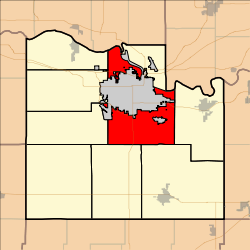
Edward and Rebecca show up next on the 1860 US Federal Census in Wakarusa Township (which surrounded the city of Lawrence), Douglas County, with their children Delila J. (16), Susan (8), Allen M. (5), John (3, b. 1857), and Mary A. (2, b. 1859).

Excerpt from the 1860 US Federal Census
[There is a typo listing him as "J B Johnson" but the names, ages, and birth places of the rest of the family, in addition to the residence in Douglas County near the Lawrence post office is correct. JH Van Winkle, the hired laborer listed, is probably Rebecca Van Winkle Johnston's brother or nephew.]

Douglas County: Wakarusa Township shown in red around the city of Lawrence in grey. (from Wikipedia)

The next trace of Edward is in the record of his marriage to his second wife, Eliza Ann Hatton.

Fourth from bottom: "Johnston, E. B., of Douglas co., and Eliza A. Hallier [sic], of Jefferson co., mar. June 16, 1864, by A. G. Sherwood, J. P."

Eliza A. Hatton, daughter of Adam and Mary Hatton, age 26 in 1860, born in Kentucky, and (I think it says) a "Tayloress" in Kentucky Township, Jefferson County, near the Oskaloosa post office.

Sometime between 1860 and 1864, Rebecca must have died, but I can't find any record of her death or a grave site. I also don't find any listing of her name as a victim of the Bleeding Kansas violence, such as Quantrill's Raid on Lawrence in 1863.

She just disappears, and on the 1870 US Federal Census, Edward and Eliza Johnston are listed with their children, Susan (17), Allen M. (15), John (13), Mary A. (11), and William (5, son of Eliza and E.B.). Delila Jane is missing because she had married Thomas Moon in 1864. They are located near the Perry post office, Kentucky Township, Jefferson County, which was immediately to the north of Lawrence across the Kansas River and nearer to Eliza's parents.

Excerpt from 1870 US Federal Census

They show up again on the 1875 Kansas State Census in Beaver Township, Cowley Co., near the Winfield post office.

EB Johnston (58), Eliza (41), Susan had left home and her whereabouts are unknown to me, Allen (19), John (18), Mary (16), WA (10), Jesse C (4, son of Eliza and EB), Maude Johnston (10; I have no idea who this is, although the name runs in later generations of the family), and Edward (9 months, son of Eliza and EB).

And the last we see of E.B. and Eliza is the 1880 US Federal Census for Hendricks Township, Chautauqua Co., which was right on the southern border between Kansas and the Osage Reservation.

Edward (63; listed as suffering from Paralysis, father's place of birth is "Ocean" and mother's is Virginia), Eliza (47), John H. (23), William A. (15), Jesse C (9), and Edward (5). Also, there is a border, Alexander Crody (26) who is a "Gentleman" from Virginia!


My great-great-great-grandfather, Allen McGee Johnston, had married Margaret Ann "Maggie" Huff in 1876, and they were still living in Cowley Co. in 1880 with their four-year-old daughter Dolly May and their one-year-old son Miles Robert, who was my great-great-grandfather.

Allen McGee would go on to run the Cherokee Strip Land Run of 1893 in Oklahoma Territory. The claim did not have enough water on it to farm so the family ended up moving to Pawhuska in the Osage Reservation one year later.

The rest, as they say, is history.

Wednesday, March 5, 2014

Cream of Tomato Basil Soup and Nostalgia

When I walked out of the bathroom stall she was standing there at the sink, drying her hands veerry sloooowwly on a paper towel. She looked like a tall version of Velma from Scooby Doo - wide set eyes and freckles behind a pair of dark librarian glasses and an auburn bob haircut.

"Aren't you one of the girls on my floor? What's your name again? I'm Wendy." She extended a very dry hand for shaking.

"Yeah, I'm Amanda. I'm down the hall."

"Did you know this was going to be a religious thing? I missed the part about this being at the Baptist Student Union. I thought it was just free pizza," she said, trying to suss out my level of involvement in our present situation.

"No, definitely not. That girl just said there was a place on campus giving out free pizza for move-in day. She did NOT say it was the Baptist Student Union, and I'm pretty sure we aren't even ON campus any more," I griped with relief at having found a compatriot also hiding out in the ladies' room.

"Wanna try to sneak out of here? I'm ready to GO."

"I think I saw a side exit door around the corner. We'll have to try to figure out how to get back to the dorm, but it's better than staying here."

It was our first day at college. We'd just moved in to student housing with the rest of the freshman and had been assigned rooms down the hall from one another. Everyone on our floor was new except for the one uber-friendly Senior girl who had introduced us all to each other and invited us to tag along with her and her friend to get pizza for dinner. Growing up in the Bible Belt as we both did, we should've been more suspicious. In hindsight, we'd both tell you that there's no such thing in this world as free pizza.

But after that harrowing adventure, we were the best of friends. We ate most the rest of our meals together in the neutral safety of official campus food services facilities. We hung out in each other's rooms and took classes together. We went to our first college party together. We rented our first college apartment together.

We soon established a Saturday afternoon ritual of doing laundry and having lunch and coffee at the local French bakery on Campus Corner. They had this cream of tomato basil soup that we both loved, served with a crunchy-on-the-outside-chewy on-the-inside French bread roll. Scraping up the few dollars for a bowl of soup and an iced coffee was well worth the sophisticated luxury of chatting away the afternoon in a college-town sidewalk cafĂ©. Our ritual was proof that we were not like those BSU girls, blonde and bouncy and worried about what Jesus would think of us. We were worldly, intellectual, independent, and brave.

To this day, I have an emotional connection to cream of tomato basil soup. Whenever it's on the menu, I usually have to give it a try. I keep an eye out for recipes that seem like they'll replicate the taste from my memories, but it's hard to find just the RIGHT soup. This winter, I have finally found a recipe I like quite a bit. It's super easy to make, and the girls and Mike will eat it happily, so it's a win for everyone. I can't get those French bread rolls, but you can't beat a grilled cheese to go with tomato soup, and I do have access to some rather superior Italian scali bread.

My recipe comes from Mark Bittman's How to Cook Everything (which I highly recommend)...

Cream of Tomato Soup

2 tablespoons of butter
2 tablespoons of tomato paste
1 large onion
1 carrot, diced
salt and freshly ground black pepper
4 cups peeled, seeded, and chopped tomato (canned is fine; include the juices) [Having experimented with this, I recommend the big cans of imported, Italian branded chopped tomatoes. They really do taste sweeter.]
1 teaspoon fresh thyme leaves or 1/2 teaspoon dried thyme or 1 tablespoon chopped fresh basil leaves [Obviously, I use basil]
1 cup cream or half-and-half
1 teaspoon sugar (optional)
Chopped fresh parsley or basil leaves or crouton for garnish (optional) [Or grated parmesan, because there's no such thing as too much dairy in my universe.]

1. Put the butter in a large, deep pot over medium heat. When hot, add the tomato paste and let it cook for a minute, then add the onion and carrot. Sprinkle with salt and pepper and cook, stirring, until the onion begins to soften, about 5 minutes.

2. Add the tomato and the herb and cook, stirring occasionally, until the tomato breaks up, 10 to 15 minutes. [I'm no professional chef, for sure, but the first time I made this soup, it tasted thin and acidic and too tangy. I discovered that it needed a LOT more salt than I had put in. Keep adding it until the soup suddenly tastes delicious. I think the tomato is just so acidic it needs the salt for balance, even if it feels excessive to you.]

3. Add the half-and-half and puree the soup carefully in a blender, with an immersion blender, or through a food mill. [I LOVE my immersion blender! Worth every penny.] Reheat, garnish, and serve.

As I said, these days I serve this for dinner with grilled cheese sandwiches for my girls and we probably listen to some Shovels and Rope while we eat. But if you really want to do it up right, old skool, put on some black leggings, Doc Martens, and a huge sweater. Make yourself an iced coffee in a pint glass. Put some Bob Marley on the stereo and set your old, tattered copy of To the Lighthouse next to your bowl. Then call your friend, Wendy, and catch up. [I need to call my friend, Wendy.]

Wednesday, January 22, 2014

#WhereILivedWednesday: Guthrie

The school bus dropped me off at the corner where the red-dirt Rural Route 61 met the two-lane state highway headed out of town towards the Indian Meridian. I picked my way carefully between the ruts and gullies in the road as it sloped gently up past the quarter-mile row of widely spaced houses on the right. Behind the wall of cedar trees on the left lay nothing but a great expanse of cattle pasture.

My house, the house my parents were renting until our old place in the previous town finally sold, was the very last one in the line. A brown brick ranch, it crouched against the prairie, huddled in the angry wind. It seemed to shy away from the house next door as it was situated on the lot closer to the barbed wire fence that separated the lawn (if you could even call it that) from the pasture beyond us, making it appear that we preferred the lowing herd of cattle to our human neighbors.

I trudged up the long gravel circle drive (where I would later learn to drive a stick shift) and let myself in the front door. Everything in the house was dark brown: the shag carpet, the woodwork, the heavy drapes, the wall of brick surrounding the fireplace, the kitchen tile. Unfortunately, my parents' furniture was also all brown, amplifying the feeling of living in a dark, warm hole in the ground. Like a prairie dog den, or the sod houses of our frontier forebears.

Some days when the weather was less brutal than usual, after dumping my backpack and changing into shorts, I would take a notebook and a snack and head back down the driveway and around the corner of the pasture fence out into the uninhabited, untraveled section of the road. Past the line of houses, the windbreak of cedars across the street came to a sudden end and the red clay road ran up between open vistas of grassland on either side. It finally crested the long, low rise right in front of an old, boarded up one-room country schoolhouse before rolling back down to end at an intersection with another two-lane state highway below.

The pasture fence formed a neat square around the back of the ramshackle clapboard school, and someone mowed the grass down around it semi-regularly. From my perch on the peeling front steps, I could study the endless miles of country that tumbled in lazy swells and fanned out in a flat, vast plain under the bowl of turquoise sky. Patches of irrigated green wheat fields hopscotched across the expanse of dry prairie where tall, brown grasses whispered back to the wailing wind. A lonely farmhouse with a sagging porch and a yard full of trucks stood in the shadow of an actual windmill. In the distance, the red-brick town, a series of repeating rectangles within rectangles, sat tucked into the elbow formed by the slash of beige Interstate crossing the muddy Cimarron River.

The land was so flat and wide and the visible horizon was so incredibly distant that any people present in the landscape were dwarfed to invisibility, leaving me with the feeling of being the only living creature alone in a giant glass-domed terrarium. With so much of a view, I wondered how there could possibly be so little to see. How far would I have to go past that point where the highway disappeared into the china blue sky before I found something, anything?

The Brown House was supposedly a temporary doldrums, a pit stop during a time of transition, but years later we were still drifting around in it, biding our time, waiting for the winds to change. As the teenager in the household, I believed I felt the impotent passage of time more acutely than everyone else, even though I was counting down the years to a specific, known moment when my life would surely begin. By what method did my parents count down their own uncertain time? When they walked up the road and looked out over the landscape, was there something in that view that they were longing for?

They did finally sell the old house and build a new, brighter house on the other side of town at the beginning of my senior year. My brother mostly grew up in that house, and my parents live there still, but I did not stay there very long. Just a small handful of months after the move, I was headed out of town on that Interstate highway, bound for college and the wider world beyond that vanishing point on the horizon where you can no longer see where the road goes.

Wednesday, December 18, 2013

#WhereILivedWednesday

I wrote this after reading a new series named #WhereILivedWednesday on a blog I follow called Ann's Rants. Hopefully she'll be doing more of these because I enjoyed reading other people's memories of past homes.


My great-grandmother Elizabeth moved to a nursing home when I was four. Her little house on Tenth Street was empty, so my parents bought it and returned from the suburbs of Tulsa to their hometown. That's how I ended up sleeping in my Nana's childhood bedroom, two doors down from the house where my mother grew up.

My great-grandparents came out from Jackson, Tennessee, in 1920 to work in their brother-in-law Charlie’s dry goods store. Just a couple of decades before, the Creek Indian Nation had been forced by the Dawes Commission to enroll its members and accept private allotments of their reservation land in preparation for statehood. All “surplus” land was sold by the federal government to white settlers. The massive Glenn Pool oil field to the north and the coal mines to the south filled the booming town with refineries and manufacturing plants. When my great-grandparents arrived, new telephone lines and unpaved streets were laid out awaiting the homes of the fortune-seekers who were flooding into the former Indian Territory.

Elizabeth and John built a two-bedroom craftsman bungalow on one of those new streets. A deep, cool front porch stretched across the entire width of the house, with French doors that opened onto the living room and the front bedroom. There was a spacious dining room with more French doors, a kitchen with an alcove for the breakfast table, a bathroom, and a small back bedroom for the children.

My Nana Ruth and her sister Annie grew up there from the jazz-paced growth and oil money opulence of the ‘20s through the Dust Bowl years of the ‘30s when John took to the bumpy roads selling candy door-to-door. Ruth married one of the GIs who came pouring into town during the War and they quickly had four children. Looking for a home of their own during the housing shortages of the 1950s, they decided to buy the Victory Garden plot on Tenth Street. They built a small ranch-style home within spitting distance of Ruth’s parents. The Hardwicks, who lived in the house between them, never minded when I cut across their backyard to my grandparents' house just as my mother had done.

When we moved in, the refrigerator was out on the back porch. There were only six ancient glass fuses in the electrical box and no central air-conditioning -- only the old attic fan that sounded like a freight train and made you feel like you were floating when it sucked all the air up into the ceiling. The driveway was unpaved. The light switches were black push-buttons. My parents spent all their savings updating the place, even renovating the only bathroom while my mother was hugely pregnant with my brother in 1983.

But the wallpaper in my bedroom never changed. It was the same toile paper that had been on the walls when my Nana slept there, faded from it's original color to a dingy taupe on a yellowed background. The kitchen also stayed the pea green color that my Uncle Karl had painted it sometime in the ‘70s.

The headboard in my parents' room was stained by John's hair oil. I tried on my mother’s jewelry at Elizabeth’s dressing table on the stool with the needlepoint seat she stitched herself. We put up our Christmas tree in the same corner of the living room by the fireplace where it had always stood.

On rainy days, I played on the wide porch where my mother once fell and split her forehead open. My parents put up a swing set under the big magnolia tree by the back stoop where, according to my Nana, disheveled men had come up from the alley to the back door to beg for spare food during the Depression. Also the town bootlegger would come in that way to deliver your hooch if you called him up on the telephone and left the light on.

I went to the same elementary school as my mother and grandmother. My music teacher had been my mother’s teacher. We also had the same Sunday school teacher at the First Presbyterian Church where my Nana was an Elder. Same choir director, too, although different minister.

And then things changed, as they do. My father was transferred by his company to another small town north of Tulsa. My parents had to sell the little bungalow on Tenth Street, and it passed out of our family for good.

We came back regularly to visit my grandparents down the street. The new people kept the old place looking nice, but it was disconcerting to see the changes they made. It felt odd not to run back and forth between the two houses anymore. I never asked my Nana how she felt, living two doors down from her old home without being able to pop in any time she liked to commune with her memories there. I can’t imagine it wasn’t painful at times, especially after her mother passed away.

I myself have only driven down that street a few times in the last decade, especially now that Nana doesn't even live there either. It’s still surreal and melancholy, even though so much time has passed. I'm sure the Creeks could tell us exactly how impossible it is to kill that sense of longing for your lost home.